
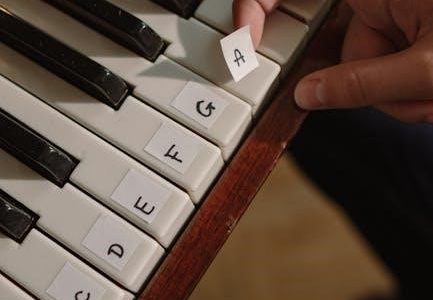
Fur Elise Sheet Music PDF with Letters: A Comprehensive Guide (Updated 12/04/2025)
Today, December 4th, 2025, discover simplified “Für Elise” sheet music in PDF format, featuring lettered notes for beginners! Access complete scores with notes and labels, aiding piano learning.
Understanding “Fur Elise” and its Popularity
“Für Elise”, formally known as Bagatelle No. 25 in A minor (WoO 59), holds a unique place in popular culture, captivating listeners for generations. Its enduring appeal stems from its memorable melody and emotional depth, despite its relatively simple structure. The availability of sheet music with letters significantly contributes to its accessibility, particularly for novice piano players.

The ease of learning with lettered notes removes the initial barrier of traditional music notation, allowing individuals to quickly engage with the piece. PDF versions further enhance convenience, offering readily available and printable resources. This accessibility explains why countless online tutorials and piano learning apps feature “Für Elise” as a foundational piece. The combination of a beloved melody and simplified learning materials ensures its continued popularity among aspiring musicians.
The Historical Context of Beethoven’s Composition
Ludwig van Beethoven composed “Für Elise” around 1810, during a period of increasing hearing loss and personal turmoil. While the identity of “Elise” remains debated – theories range from a student to a noblewoman – the piece wasn’t published during his lifetime. Its discovery came decades later, adding to its mystique.
Interestingly, the piece’s initial form differed from the familiar version we know today. The availability of modern sheet music PDF versions, especially those with lettered notes, allows contemporary learners to access a refined arrangement. The simplified notation bridges the gap between Beethoven’s era and modern piano education, making his masterpiece approachable. The enduring legacy of “Für Elise” is amplified by these accessible learning tools.
Why Sheet Music with Letters is Beneficial for Beginners
Sheet music with letters, particularly in PDF format, dramatically simplifies learning piano for novices. Traditional notation can be daunting; lettered notes directly correlate to piano keys (A, B, C, etc.), fostering quicker recognition and reducing cognitive load. This method bypasses the initial hurdle of note reading, allowing students to focus on rhythm and finger placement.

For “Für Elise,” a piece with a recognizable melody, lettered sheet music accelerates the learning process. Beginners can quickly play recognizable phrases, building confidence and musicality. The readily available PDF downloads offer convenient practice access, supporting self-paced learning and making Beethoven’s classic attainable for all.
Locating Free “Fur Elise” Sheet Music PDF Resources
Finding free “Für Elise” sheet music PDF resources with letters is surprisingly accessible online. Mutopia Project stands out as a reliable source, offering public domain scores downloadable in PDF format. Numerous other websites also provide free PDF downloads, though quality and accuracy can vary.
A quick search reveals options presenting lettered notes alongside traditional notation, catering specifically to beginners. Websites dedicated to piano tutorials often include downloadable sheet music as supplementary material. Remember to preview the PDF to ensure clarity and accuracy before committing to learning from it. Always prioritize reputable sources for the best learning experience.
Mutopia Project: A Reliable Source for Free Scores
Mutopia Project emerges as a premier destination for free “Für Elise” sheet music PDF downloads. This website specializes in public domain scores, ensuring legal and ethical access to classical compositions. Their offerings include versions with lettered notes, specifically designed to assist beginner pianists in deciphering the music.
The PDF files from Mutopia Project are generally high-quality and accurately transcribed. You can confidently download and print these scores for personal use. Sheet music is free to download, with the freedom to use it for learning and performance. It’s a fantastic resource for anyone seeking reliable, lettered “Für Elise” arrangements without cost.

Other Websites Offering Free PDF Downloads
Beyond Mutopia Project, several other online platforms provide free “Für Elise” sheet music PDF versions, often including those with lettered notes. Numerous websites cater to beginner piano players, offering simplified arrangements. However, exercise caution when downloading from less-known sources to ensure score accuracy and legality.
Some sites host user-submitted transcriptions, which may vary in quality. Always preview the sheet music before downloading to confirm it meets your needs. Look for sites with clear licensing information and positive user reviews. Remember to verify the accuracy of lettered notes against a reliable recording to guarantee a successful learning experience.
Decoding Sheet Music: Basic Elements for Beginners
Understanding fundamental sheet music elements is crucial before tackling “Für Elise” with lettered notes. Begin with recognizing the staff – five horizontal lines and four spaces – where notes are placed. Each line and space represents a specific pitch. Learn to identify notes by name (A, B, C, D, E, F, G), relating them to their position on the staff.
Familiarize yourself with time signatures, indicating the rhythm and beat structure. Key signatures reveal sharps or flats, altering specific notes throughout the piece. Understanding these basics, alongside note durations (whole, half, quarter), will unlock the PDF and lettered notation, enabling confident interpretation of Beethoven’s masterpiece.
Understanding Note Names (A, B, C, D, E, F, G)
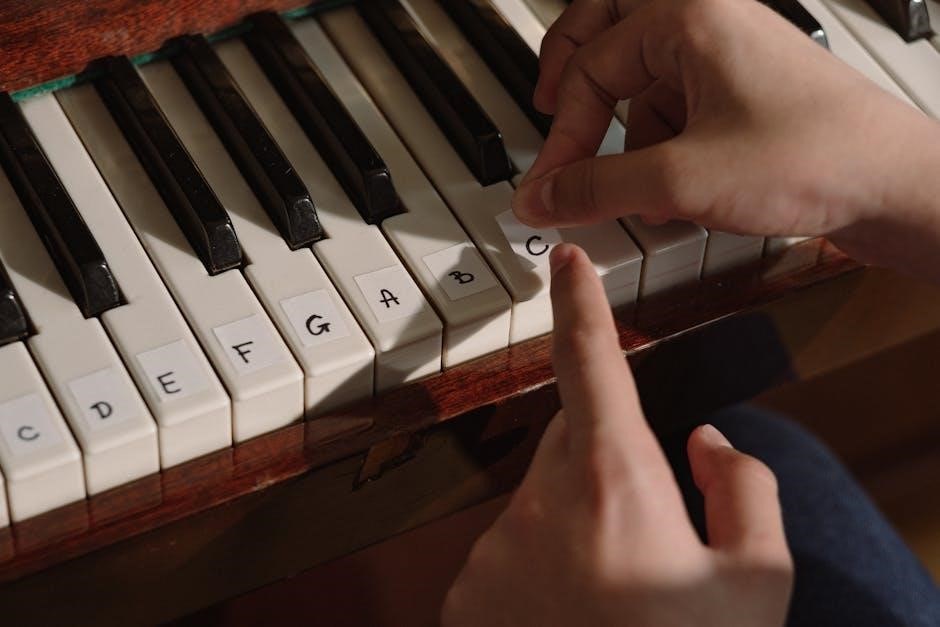
When using “Für Elise” sheet music PDF with letters, mastering note names (A, B, C, D, E, F, G) is paramount. These letters correspond to specific keys on the piano. Visualize the keyboard; notes repeat in patterns. The lettered notation directly links these names to the visual representation on the staff.
Begin by associating each letter with its position relative to black keys – a crucial landmark. For example, C is always to the left of a group of two black keys. Practice identifying notes quickly, both on the sheet music and on the piano. This foundational skill will accelerate your ability to play “Für Elise” accurately and confidently.
Recognizing Time Signatures and Key Signatures
When navigating “Für Elise” sheet music PDF with letters, understanding time and key signatures is vital. The time signature (3/4 in this piece) indicates three beats per measure, influencing rhythm. Count “1, 2, 3” repeatedly while playing to internalize the beat.
The key signature (A minor) reveals sharps or flats affecting certain notes throughout the piece. While lettered sheet music simplifies note reading, recognizing the key helps anticipate these alterations. Pay attention to any accidentals (sharps, flats, naturals) within the PDF, as they modify the corresponding lettered notes. Mastering these elements enhances musical comprehension and accurate performance.
“Fur Elise” Sheet Music with Letters: A Detailed Breakdown
Exploring “Für Elise” sheet music PDF with letters unlocks this iconic piece for beginners. The lettered notation directly corresponds to piano keys – A, B, C, D, E, F, and G – simplifying note identification. Begin with the main melody (A-E-A-C-E), practicing slowly and accurately.
The PDF will present these letters sequentially, indicating the order to play the notes. Focus on rhythm alongside the letter names. Online tutorials complement this approach, offering visual and auditory guidance. Remember, consistent practice with lettered sheet music builds a foundation for transitioning to traditional notation, enhancing your overall musical skills.
The Main Melody – Note-by-Note with Letter Labels
Let’s dissect the opening of “Für Elise” using lettered notation! The iconic melody begins: E-D#-E-D#-E-B-D-C-A. Your PDF sheet music will display these letters above or below the corresponding notes, making it accessible for beginners. Pay close attention to the sharps (#) – D# indicates D sharp.
Practice this sequence slowly, focusing on accuracy. The rhythm is crucial; each letter represents a specific duration. Repeated practice will build muscle memory. Remember the sequence: E-D#-E-D#-E-B-D-C-A. Utilize online resources alongside your PDF to hear the correct timing and phrasing, enhancing your learning experience.
Analyzing the A Section: Identifying Patterns and Repeats
The “A” section of “Für Elise”, readily visible in your PDF sheet music with letters, is built upon repeating melodic phrases. Recognizing these patterns accelerates learning. Notice how the initial motif – E-D#-E – recurs with slight variations throughout this section.
Your lettered sheet music highlights these repetitions, allowing you to anticipate upcoming notes. Focus on the harmonic structure; the chords supporting the melody also follow predictable progressions. Identifying these repeating elements reduces the cognitive load, enabling smoother performance. Mastering the A section provides a solid foundation for tackling the entire piece.
Different Formats of Sheet Music with Letters (PDF, Images)
“Für Elise” sheet music with letters appears in two primary formats: PDF documents and image files (like JPG or PNG). PDFs offer advantages – they’re easily printable, zoomable without pixelation, and generally maintain formatting across devices. However, PDF readability depends on having a PDF viewer installed.
Image-based sheet music is universally accessible, viewable in any web browser or image viewer. Yet, image quality impacts clarity; low-resolution images can make note and letter identification difficult. Furthermore, zooming in on images often results in pixelation. Choose a format based on your printing needs and device capabilities, prioritizing clarity for successful learning.
Advantages and Disadvantages of PDF Format
PDF format for “Für Elise” sheet music with letters offers significant benefits. It’s universally compatible, preserving formatting across various operating systems and devices. PDFs are easily printable at any size, crucial for practice. Zooming functionality maintains clarity, unlike images. They also support annotations, allowing you to mark fingerings or difficult passages directly on the score.
However, PDFs require a PDF reader, which most devices have, but not all. Large PDF files can be slow to load. Editing a PDF to customize the sheet music is often complex and requires specialized software. Consider these factors when choosing between PDF and image-based formats.
Considerations When Using Image-Based Sheet Music
Image-based “Für Elise” sheet music with letters, like JPEGs or PNGs, presents unique challenges. While readily viewable without specific software, image quality is paramount; low resolution leads to blurry notes, hindering learning. Zooming can exacerbate pixelation, making lettered notes illegible. Printing may result in distortion if the original image isn’t high-resolution.
Unlike PDFs, images aren’t easily annotated. Adding fingerings or practice notes requires external editing tools. Furthermore, image files lack text searchability, making it difficult to locate specific sections. Carefully evaluate the source and image quality before relying on image-based sheet music for effective learning.
Tips for Learning “Fur Elise” with Lettered Sheet Music
Begin learning “Für Elise” with lettered sheet music by starting incredibly slowly, prioritizing accuracy over speed. Focus on correctly identifying each letter and corresponding piano key. Utilize online tutorials and piano learning apps alongside the sheet music for visual and auditory reinforcement. Break the piece into smaller, manageable sections – perhaps just the iconic A section initially.

Practice each hand separately before combining them. Consistent, short practice sessions are more effective than infrequent, lengthy ones. Don’t hesitate to mark your PDF with fingerings to aid memorization. Remember, patience is key; mastering this beautiful piece takes time and dedication!

Starting Slowly and Focusing on Accuracy
When utilizing “Für Elise” sheet music with letters, resist the urge to play at tempo immediately. Begin at a snail’s pace, deliberately focusing on placing each finger on the correct key represented by the letter. Accuracy is paramount; incorrect notes ingrained early are difficult to correct later. Prioritize a clean, precise sound over speed.
Use a metronome, even at a very slow BPM, to develop a consistent rhythm. Repeatedly practice small sections until they are flawless before gradually increasing the tempo. Remember, building a solid foundation of accuracy will ultimately lead to a more fluid and enjoyable performance.
Utilizing Online Tutorials and Piano Learning Apps
Complement your “Für Elise” sheet music with letters by leveraging the wealth of online resources available. Numerous YouTube tutorials demonstrate proper hand positioning and fingering for this iconic piece. Piano learning apps often feature interactive lessons and playback options, allowing you to hear correct phrasing and timing.
These digital tools can visually reinforce the lettered notes, providing a multi-sensory learning experience. Search for tutorials specifically designed for beginners using lettered sheet music. Many apps offer features like slowing down the tempo and looping difficult sections, accelerating your progress. Explore options to enhance your learning journey!
Beyond the Basics: Exploring More Advanced Sheet Music
Once comfortable with the lettered “Für Elise” PDF, transition to traditional sheet music notation. This builds a deeper understanding of musical structure and expands your repertoire. Begin by comparing the lettered version to standard notation, identifying note positions on the staff.
Gradually incorporate dynamics and expression markings – elements often simplified in beginner arrangements. Explore different editions of “Für Elise”, noting variations in interpretation. Understanding these nuances elevates your performance. Continue practicing scales and chords to strengthen your technique, preparing you for more complex pieces.
Transitioning from Lettered Notes to Traditional Notation
Moving beyond lettered sheet music is crucial for long-term piano development. Start by correlating each letter (A, B, C, etc.) with its corresponding position on the musical staff. Practice identifying notes visually, without relying on letter prompts. Utilize the PDF version alongside standard notation, comparing and contrasting the two systems.
Focus on recognizing patterns and intervals. Understanding these concepts accelerates the learning process. Gradually reduce your dependence on lettered aids, challenging yourself to read directly from the staff. Remember, consistent practice is key to mastering traditional notation and unlocking a wider range of musical possibilities.
Understanding Dynamics and Expression in “Fur Elise”
While lettered PDF sheet music simplifies note reading, it often lacks dynamic markings. “Für Elise” thrives on subtle shifts in volume and emotion. Listen to professional recordings, paying close attention to piano (soft) and forte (loud) passages.
Experiment with touch – a lighter touch creates a softer sound, while a firmer touch produces a louder one. Introduce crescendos (gradually getting louder) and diminuendos (gradually getting softer). These nuances bring the piece to life. Explore phrasing; shape the melody with slight pauses and variations in tempo to convey feeling.
The Role of Fur in Historical Garments (Contextual Note)
Interestingly, the term “Für” historically relates to lining garments with animal fur – a practice prevalent during Beethoven’s era. Initially, “fur” was a verb describing this process, evolving into the noun we know today. Luxurious furs signified status and provided warmth.
While seemingly unrelated to “Für Elise” sheet music PDF with letters, this etymological connection offers a fascinating historical context. Beethoven composed during a time when fur was integral to fashion and daily life. Understanding this detail adds a layer of appreciation for the cultural backdrop of his composition, even as we simplify learning through lettered notation.

Types of Fur Used in Traditional Clothing
Historically, diverse furs graced garments, each possessing unique qualities. Thick underfur combined with oily guard hairs provided exceptional insulation. Common choices included beaver, otter, fox, and mink – prized for their softness and warmth. These weren’t merely functional; they denoted wealth and social standing.
Though distant from “Für Elise” sheet music PDF with letters, recognizing these historical materials highlights the era’s craftsmanship. While learning piano via simplified notation, it’s intriguing to consider the luxurious fabrics contemporaries of Beethoven would have worn. The availability and cost of fur influenced fashion, mirroring the accessibility of musical education – a parallel worth noting.

Ethical Considerations Regarding Fur Usage (Brief Mention)
Contemporary discussions surrounding fur involve significant ethical concerns regarding animal welfare. While historically integral to clothing, modern sourcing practices face scrutiny. This context, though seemingly unrelated to accessing “Für Elise” sheet music PDF with letters, prompts reflection on responsible consumption.
Choosing ethically sourced materials, or exploring alternatives, aligns with a broader awareness of sustainability. Just as simplified sheet music democratizes access to music, mindful purchasing empowers consumers. Considering the origins of materials – even those distant from piano learning – fosters a more conscious approach to lifestyle choices and artistic pursuits.